Prop firm consistency rule: math, traps and a daily routine
The consistency rule caps how much profit one day can carry. The math, 4 questions to ask your rulebook, and a journal routine so your payout doesn't get locked.
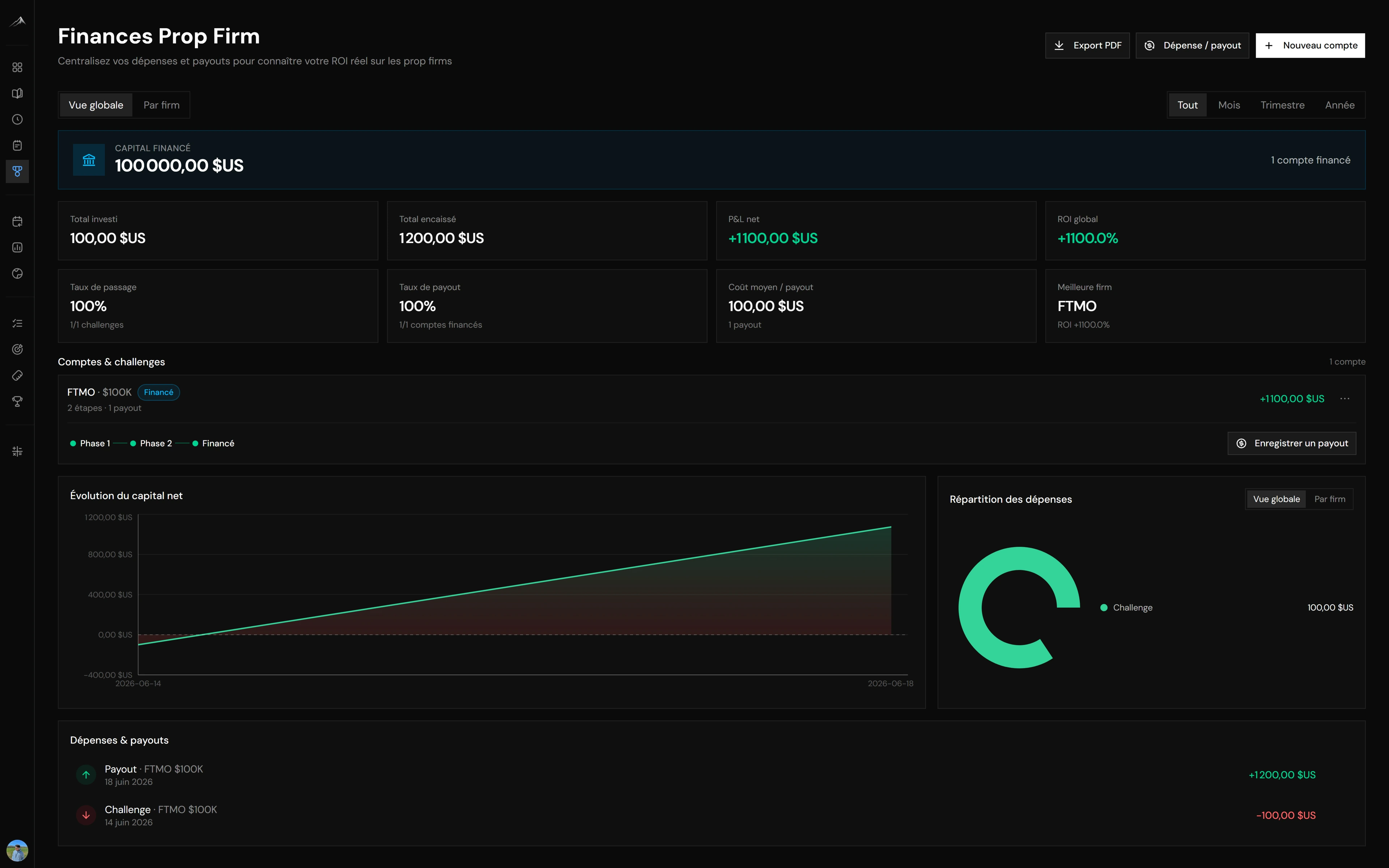
The consistency rule is the prop firm rule that catches the most profitable traders off guard. You hit the target, you respect the drawdown, and the challenge still isn't passed, or the payout stays locked. The reason: one single day carries too much of your profit. This guide covers the calculation, the definition traps, and above all how to manage the rule day to day with your journal, before it becomes a problem.
What is the consistency rule?
It's a cap on how much of your profit can come from one trading day. The firm sets a percentage threshold. If your best day goes above it, the condition isn't met.
For the firm, the goal is to check that the result comes from a repeatable method, not from one lucky session.
Three things to know right away:
- It's not a daily profit limit. You can have a big day. It just has to be "diluted" by other winning days.
- It's often not a breach. At many firms, going over doesn't close the account. It delays the pass or the payout. Some rules are stricter though: only your firm's rulebook counts.
- It ignores drawdown. An account can respect every loss limit and still fail consistency. For loss limits, see our guide on prop firm drawdown management.
The calculation in one line
The basic formula:
consistency ratio = best day profit ÷ total profit for the period
If the ratio is under the threshold, you're compliant. If not, you need more profit spread over other days.
Two derived formulas are the ones you'll actually use. Call the threshold T (0.40 for 40%).
- Minimum total profit = best day ÷ T. That's the total you need for your best day to drop back under the threshold.
- Session cap = T × P ÷ (1 − T), where P is your cumulative profit before the session. That's the maximum gain for the day that keeps you under the threshold.
Fictional example, hypothetical 40% threshold. Your best day is $1,200 and your total profit is $2,000. Ratio: 60%, so above. Minimum total profit: 1,200 ÷ 0.40 = $3,000. You're $1,000 short, to be made on other days without any of them going above $1,200.
Same threshold, before a session. You have $1,500 of cumulative profit. Today's cap: 0.40 × 1,500 ÷ 0.60 = $1,000. If you finish the session at +$1,000, the total goes to $2,500 and that day weighs exactly 40%.
These amounts are calculation examples, not firm data.
4 questions to ask your rulebook
Two firms showing the same percentage can apply two very different rules. Before calculating anything, find these four answers in the official rules.
- Which denominator? Net profit (losing days included), the sum of positive days only, or the phase profit target. It changes everything (see below).
- Which phase? Evaluation, funded account, payout request, or several.
- Which window? The whole evaluation, or the current payout cycle. Does the counter reset after a withdrawal?
- What happens if you go over? The target moves up, the payout waits, or the account is closed. And is the limit "at or below" or "strictly below"?
Write these four answers in your trading plan, not in your head. Rules change: reread them for every new account.
Net or positive days: the denominator trap
Fictional example. Four trading days: +$600, +$400, −$200, +$300.
- Net profit: $1,100. Your best day ($600) weighs 54.5%.
- Sum of positive days: $1,300. The same day weighs 46.2%.
With a 50% threshold, you fail in the first case and pass in the second. Same history, maybe even the same firm, but not the same program.
Direct consequence: with a net denominator, every red day makes your ratio worse. A loss lowers the total without touching your best day. That's why the consistency rule and discipline on losing days go together.
The real risk: forcing it to catch up
The math is simple. What loses accounts is what traders do once they see the ratio is too high.
The classic scenario: one big day, the payout is locked, profit is "missing". The trader sizes up to dilute faster. A loss comes, the total drops, the ratio climbs again. That's a spiral close to revenge trading, with the drawdown getting closer.
The way out is counter-intuitive: keep your normal size and let the rule resolve over time. Going over consistency usually costs days. Going over drawdown costs the account.
Managing consistency day to day with your journal
Most guides stop at the math. The useful part is turning it into a session routine.
Before the session (2 minutes). Write in your session notes your cumulative profit for the period and today's cap (T × P ÷ (1 − T)). If you're in an evaluation with a fixed target, also note what's left.
During the session. Decide in advance what you'll do if you get close to the cap. Two honest options: you stop the session, or you keep going knowing the payout will be delayed. What matters is that the decision is written before, not made in the heat of the moment.
After the session. Tag the days where you went over the cap. On the P&L calendar, a green day far above the others is exactly the day that will cause trouble at payout time.
Every week. Look at the share of your top 3 days in the total. If a few days carry almost all of the result, your edge depends on rare sessions, and consistency will be a constant fight. That tells you something about your strategy, not just about the rule.
Before paying for a challenge. Test your strategy on windows the length of an evaluation, not on a full year that dilutes everything. Our guide on how to backtest a trading strategy explains how to build those tests.
Common traps
- Using the wrong day. For the firm, a "day" follows its time zone and reset time, not necessarily your local date. An evening trade can land on the next session.
- Forgetting fees. Commissions and swaps can change a day's net result, so both the best day and the total.
- Thinking a new big day changes nothing. If a day beats your previous best day, it becomes the new numerator. Run the math again.
- Mixing up phases. A rule absent during evaluation can exist on the funded account, and the other way round. See also our prop firm risk management rules and why traders fail prop firm challenges.
Consistency in Altiora
Altiora's prop firm tracking is set up with your own rules: target, daily drawdown, overall drawdown, trailing or static, and consistency threshold. Presets are provided for FTMO, Topstep and Apex Trader Funding, and stay editable, because only the firm's website counts. The challenge mode in backtesting lets you replay the market with prop firm rules before paying for an evaluation. Details are on the best trading journal for prop firms page.
The P&L calendar and session notes complete the picture: you see your big days, and you write your cap before each session.
Want to track your consistency with your real firm rules? The 7-day trial gives you full access.
Frequently asked questions
- What is the prop firm consistency rule?
- A cap on how much of your total profit can come from a single trading day. If your best day goes above the firm's threshold, the pass or the payout is usually delayed.
- How do you calculate the consistency rule?
- Divide your best day profit by the total profit for the period. To find the total you need, divide your best day by the threshold (0.40 for 40%). Check the exact denominator in your firm's rules.
- Does breaking the consistency rule fail the account?
- At many firms, no: the target moves up or the payout waits. Some rules are stricter, so always read your program's official rulebook.
- How do you avoid breaking the consistency rule?
- Before each session, work out today's cap (threshold × cumulative profit ÷ (1 − threshold)), decide in advance what to do if you get close, and keep your normal size instead of forcing it to catch up.
About the author
L’équipe Altiora
Altiora editorial team
Altiora's editorial team brings together active traders and the product team. We write about discipline, journaling and performance analysis, grounded in how the platform actually works. We never give investment advice.
Read next

Trading money management: how to calculate position size (the 1% rule)
Trading money management is not a theory. It is a formula. Here is how to calculate position size, set risk per trade, and stay alive in a challenge as well as on a personal account.
Prop firm challenge: why most traders fail
The real reasons traders fail a prop firm challenge are not technical: risk management, drawdown, discipline. How to master them and pass.
The 5 mistakes that sink a prop firm challenge
Five concrete mistakes that get traders disqualified during a challenge, and how to avoid them from day one.
This content is provided for informational and educational purposes only. It is not investment advice, a recommendation, or an incentive to trade. Trading involves a risk of capital loss. Altiora holds no funds and guarantees no results.