Trading plan example: a concrete template you can copy
A useful trading plan fits on one page. Here is a concrete example and a template to adapt, with enough structure to trade without rewriting the rules every session.

People looking for a trading plan example usually want structure, not a magic strategy. Many already have a plan: they do not measure it. Result: every session rewrites the rules, and discipline is the first thing to go. Here is a one-page template, then how to check that you actually follow it.
What the plan must include
Markets and sessions. Example: US indices only during the London-New York overlap. Outside that window, no trade.
Allowed setups. One to three at most, each with a name. Everything else is off-plan, even if it "looks good".
Invalidation. The condition that cancels the trade before entry. The stop comes after, in the same logical place.
Risk. Max percent per trade and max daily loss. The sizing math is in money management and position size.
Stop rules. Example: two losses and the session is over. Revenge urge: a thirty-minute break, not a third trade.
Review. A fixed slot to reread the week: plan adherence rate, average R, which setup drove the result.
A short example
Session: 15:30-18:00 (CET), DAX or NAS100 only.
Setup A: pullback to a zone defined in advance, candle confirmation, stop below the zone, target at least 1.5R.
Risk: 0.5% per trade, daily stop at −1.5%.
Forbidden: martingale, widening the stop "to give it room", trading again after −2R in the day, no trades on NFP or FOMC days (economic calendar).
Journal: entry reason written before the click; on each trade, mark in a tag or note whether the plan was followed (yes/no).
You can copy this template and swap in your own setups. Keep the same grid so the plan stays auditable.
What a Notion paste is missing
The plan above fits on one page. The hole shows up in session: off-grid setup, third trade after two losses, entry with no written reason. If each trade carries a tag or note "plan followed: yes/no", an entry reason, and a setup tag, Sunday review becomes a percentage, not a feeling. That is what the journal automates: stats by tag/setup, notes, session notes for mental context.
The journal as a check
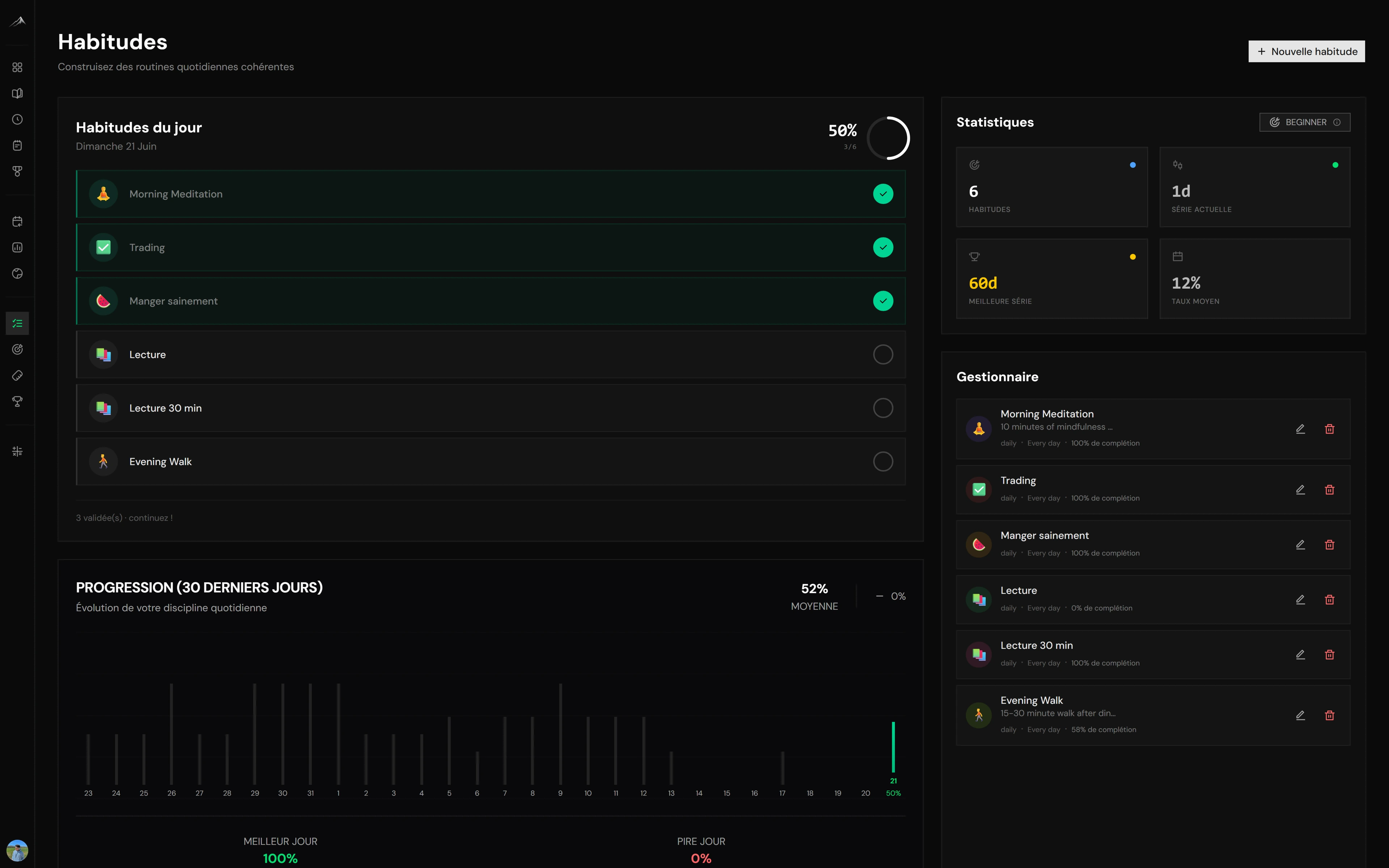
Reread a week with one question: what % of trades were off-plan? If that number is high, fix execution before adding an indicator. In Altiora that tracking uses the journal (tags, notes, filter by setup) and can pair with habit tracking (daily grid, streaks) to anchor the review and the "two losses = session over" rule.
Create an account - 7-day trial (7-day trial - card required, no charge if you cancel before day 7). Features: /features.
Frequently asked questions
- What is a trading plan?
- A short text that sets your setups, risk, sessions and stop rules before the market opens.
- Does it need to be long?
- No. If you cannot reread it in two minutes, you will not follow it under stress.
- How do you know you follow it?
- Mark each trade “plan followed: yes or no”, then count the misses at the end of the week.
About the author
L’équipe Altiora
Altiora editorial team
Altiora's editorial team brings together active traders and the product team. We write about discipline, journaling and performance analysis, grounded in how the platform actually works. We never give investment advice.
Read next

Overtrading: how to spot it and stop
Overtrading means trading outside the plan, not just clicking too much. Measurable signs, common causes, and a 7-day protocol to bring volume back in line.
Trading psychology: understanding and correcting behavioural mistakes
Discipline is not a personality trait, it is measurable data. How to identify and correct the biases that sabotage your trading.
Why I break my trading discipline (and how to fix it)
The concrete triggers that push you out of your plan, and a simple method to identify and neutralise them.