Trading money management: how to calculate position size (the 1% rule)
Trading money management is not a theory. It is a formula. Here is how to calculate position size, set risk per trade, and stay alive in a challenge as well as on a personal account.
Trading money management answers one question before every entry: how much can I lose if I am wrong? Not "how much can I make?" Until that number is explicit, you do not have a risk plan.
This page covers position size calculation, the risk-per-trade rule (often 1%), and the mistakes that fail challenges even when the edge is fine. For prop firm context, see also drawdown management and risk management rules.
The risk-per-trade rule
Pick a maximum percentage of equity you accept to lose if the stop is hit. Many retail traders stay between 0.5% and 1%. In a challenge the cap is often lower: daily drawdown does not care that the setup looked perfect.
Example: €10,000 account, 1% risk → €100 max per trade. That ceiling does not move. The stop sets distance. Size adapts. Not the other way around.
How to calculate position size
- Set risk in currency (e.g. €100).
- Place the stop where the setup is invalid.
- Measure loss per 1 lot / 1 unit if that stop is hit.
- Size = risk ÷ loss per unit.
A wide stop means a smaller size. Forcing a large size with a wide stop means you dropped money management.
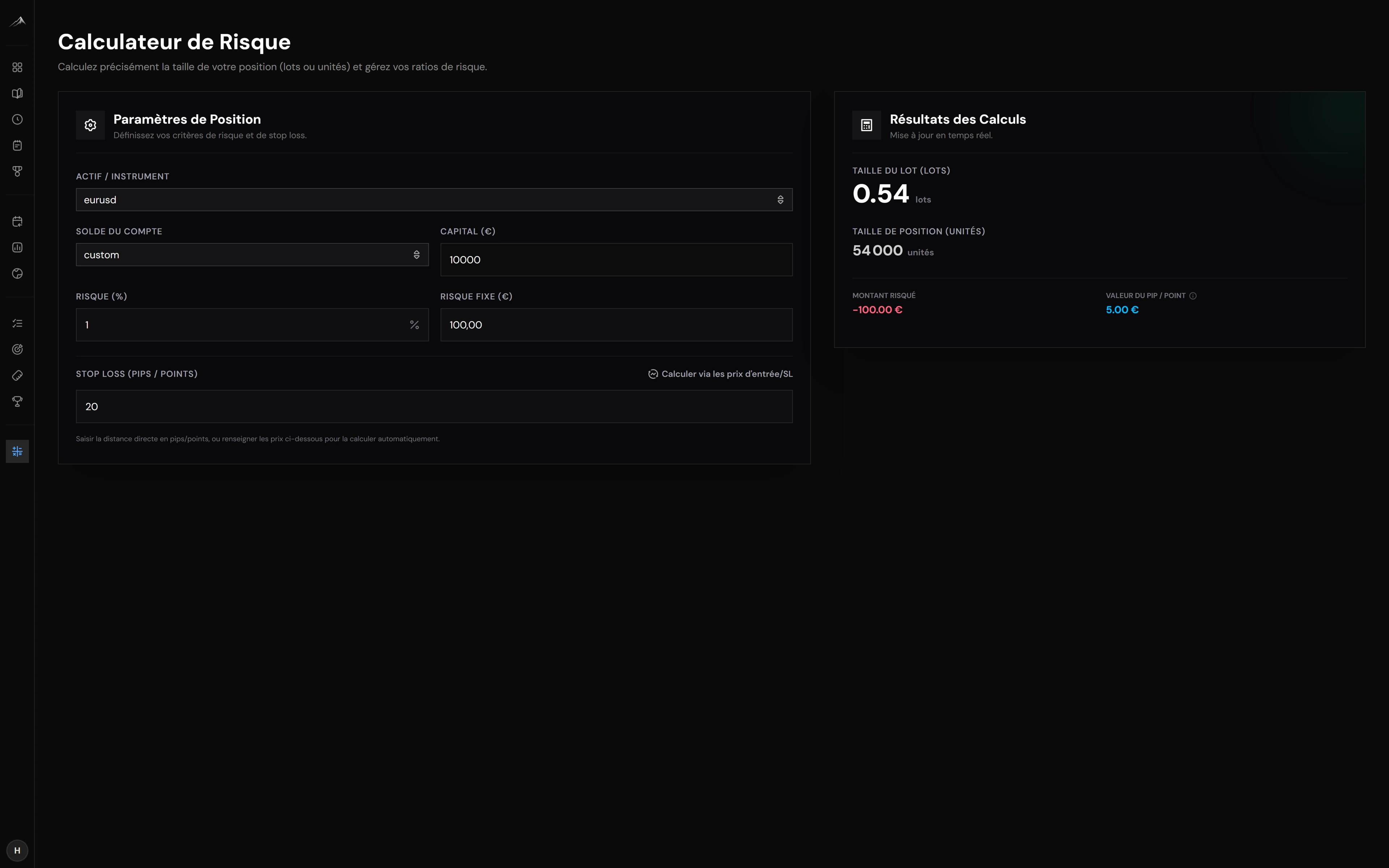
The formula fits in one line. What blows accounts is the gap between planned risk and actual risk: size rounded up, stop moved, a second trade "to get it back". Before the click, compute size (risk ÷ loss per unit). After the close, log the risk you actually took. If you want that math without a spreadsheet and tracking glued to each trade, Altiora's risk calculator sizes from account risk, stop distance and instrument; the journal then compares planned vs actual.
Worked example
Account: €10,000. Risk: 1% → €100 max.
On an index, a 20-point stop where 1 lot loses €200 if hit → size = 100 ÷ 200 = 0.5 lot.
Same account and risk, 10-point stop (1 lot = €100 loss) → size = 100 ÷ 100 = 1 lot.
The stop changes: size follows. The risk ceiling does not.
See also the risk calculator to replay this on your instrument.
What breaks money management
Increasing size after a loss. Keeping a fixed euro risk after the account has already drawn down. Ignoring daily loss limits in prop firms. Widening stops without cutting size to protect win rate.
In a challenge those gaps cost a fail, not just a curve. If you run several funded accounts, centralising rules, drawdown and cash-flow (prop firm tracking) stops you "feeling" daily loss too late. On a personal account, a day-by-day P&L calendar makes tilt days where size jumped visible.
From written rule to risk actually taken
Without tracking, 1% stays an intention. A useful review looks at three things: share of trades above the cap, real average R, and days when daily loss was approached. In a journal that computes P&L, win rate and profit factor automatically, those gaps show up without retyping. On MetaTrader or another supported broker, import avoids retyping tickets just to judge size discipline.
Try the risk calculator and journal on your next trades: 7-day trial (7-day trial - card required, no charge if you cancel before day 7). Features: /features.
Frequently asked questions
- What is money management in trading?
- The rule that sets how much you risk per trade (and therefore position size), so a losing streak does not wipe you out.
- Why risk 1% per trade?
- Ten losses at 1% ≈ −10%: painful but recoverable. At 5%, the same streak destroys the account or the challenge.
- How do you calculate position size?
- Risk in currency ÷ loss per unit if the stop is hit. Wide stop means smaller size. Never raise risk to keep size large.
About the author
L’équipe Altiora
Altiora editorial team
Altiora's editorial team brings together active traders and the product team. We write about discipline, journaling and performance analysis, grounded in how the platform actually works. We never give investment advice.
Read next
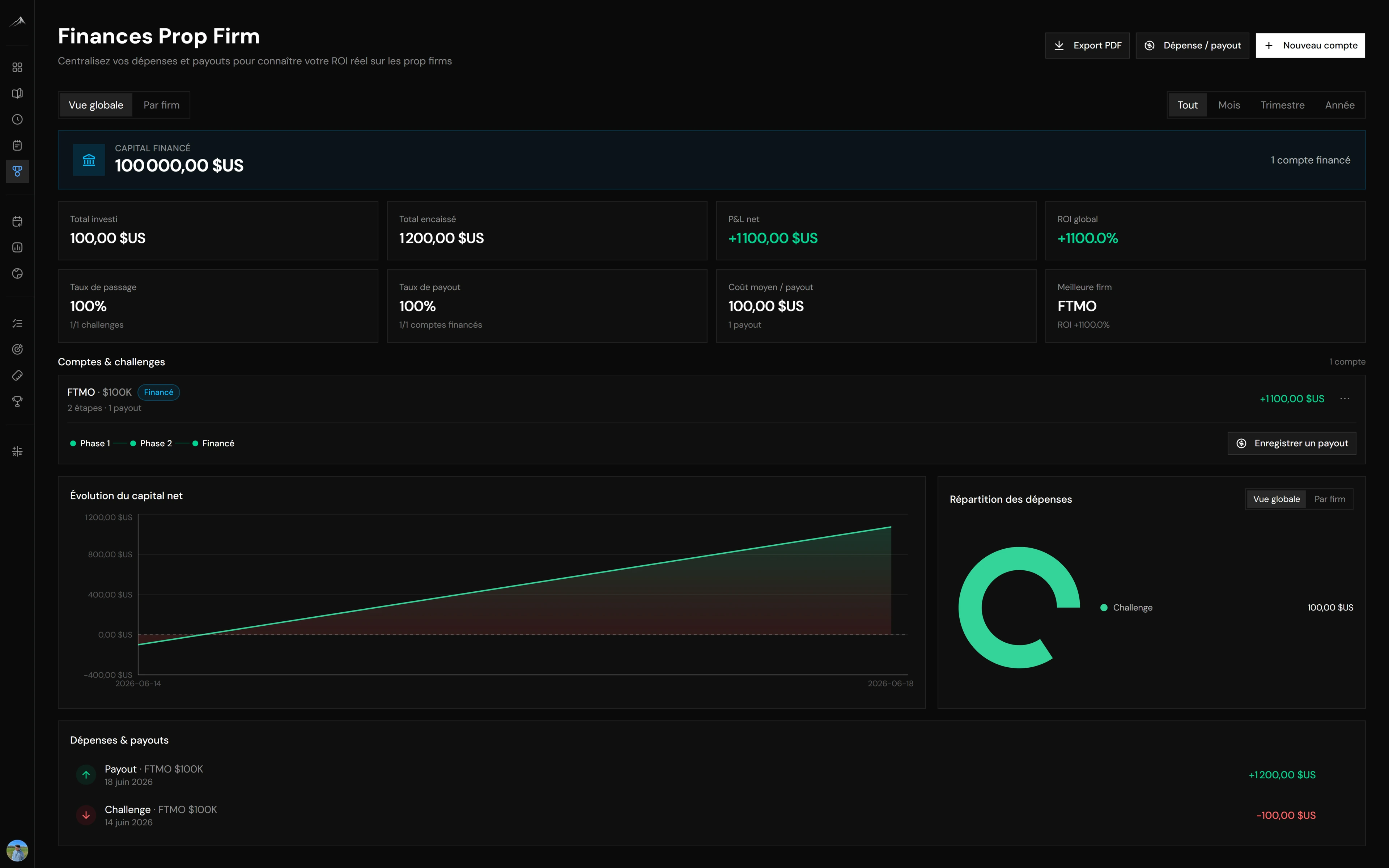
Prop firm challenge: why most traders fail
The real reasons traders fail a prop firm challenge are not technical: risk management, drawdown, discipline. How to master them and pass.
The 5 mistakes that sink a prop firm challenge
Five concrete mistakes that get traders disqualified during a challenge — and how to avoid them from day one.
How to choose your prop firm in 2026 (criteria and traps)
The objective criteria for comparing prop firms, and the traps to spot before you pay for a challenge.
This content is provided for informational and educational purposes only. It is not investment advice, a recommendation, or an incentive to trade. Trading involves a risk of capital loss. Altiora holds no funds and guarantees no results.